HVAC Technician Screening Questions
HVAC technicians need a combination of EPA-certified refrigerant handling knowledge, strong diagnostic instinct, and the communication skills to explain technical problems to non-technical customers. A good phone screen quickly separates candidates who genuinely understand HVAC systems from those who have watched training videos. These questions surface certification status, real field experience, and service commitment before the in-person.
11 questions across 4 categories
"Do you hold an EPA 608 certification? Which type - Universal, Type I, Type II, or Type III?"
What to listen for
EPA 608 Universal is required for most commercial and residential service work. Type I alone (small appliances) is insufficient for most HVAC roles. If they do not hold Universal, ask where they are in the process and whether certification is required before their start date.
"This role includes on-call coverage one week per month, including weekends. Does that work for you, and what is your average response-time expectation for an emergency call?"
What to listen for
On-call is a hard requirement for most service roles. Probe for a realistic response time expectation (typically 2 to 4 hours) and listen for whether they have managed on-call before. First-time on-call candidates may need more support structure.
"Do you have a valid driver's license and a clean driving record? This role requires operating a company vehicle daily."
What to listen for
A direct answer is needed. A DUI or suspended license is a disqualifier for roles with company vehicle requirements. If there is anything to disclose, this is the moment to surface it.
"Walk me through how you diagnose a residential split system that is running but not cooling. What is your sequence?"
What to listen for
A strong technician will describe a systematic approach - checking thermostat settings, verifying power and airflow, then moving to refrigerant pressures, delta-T at the evaporator, and electrical components. Technicians who jump straight to refrigerant without a systematic check are prone to misdiagnosis.
"What preventive maintenance tasks do you consider non-negotiable on a seasonal residential tune-up?"
What to listen for
Strong candidates will list checking refrigerant charge, cleaning evaporator and condenser coils, inspecting electrical connections, testing capacitors, and verifying airflow. A vague answer suggests either limited PM experience or a shortcut mentality.
"What refrigerant types have you worked with, and what are you most comfortable handling? Any experience with R-410A, R-32, or R-454B as equipment transitions are underway?"
What to listen for
The industry is transitioning away from R-410A under the AIM Act. Candidates familiar with A2L refrigerants (R-32, R-454B) and their additional handling requirements are ahead of the curve for commercial and new residential installs.
"Tell me about the most technically challenging HVAC repair you have completed. What made it complex and how did you work through it?"
What to listen for
Listen for specific component-level detail - TXV failure, compressor diagnosis, heat exchanger crack detection. Candidates who describe the diagnostic process as much as the repair itself have stronger troubleshooting habits.
"What commercial HVAC equipment do you have the most experience maintaining - rooftop units, chillers, VRF systems, or something else?"
What to listen for
If the role is primarily commercial, alignment between their dominant experience and your equipment profile matters significantly. Chiller and VRF experience are specialized skills that take years to develop.
"Have you used field service management software for dispatch, job notes, or invoicing? Which systems?"
What to listen for
ServiceTitan, Jobber, Service Fusion, and similar platforms are common. Technicians comfortable with mobile work order apps complete documentation more reliably. Complete unfamiliarity is trainable but adds onboarding time.
"Describe a situation where a customer was frustrated because a repair took longer than expected or did not fix the problem the first time. How did you handle the conversation?"
What to listen for
Service technicians represent your company on-site without a supervisor present. Candidates who communicate proactively, set realistic expectations, and take ownership of outcomes maintain customer relationships through difficult service calls.
"What would you do if you arrived at a job and realized the repair required refrigerant recovery but your recovery machine was back at the shop?"
What to listen for
This tests their problem-solving under real-world constraints. Strong candidates will describe communicating with dispatch, setting a realistic expectation with the customer, and not proceeding without the right equipment. Improvising refrigerant handling is both illegal and dangerous.
Practical tips
Getting more from your hvac technician screens
Ask for their EPA 608 certification number during the screen and verify it through the ESCO Institute registry before scheduling an in-person. Falsified certifications are a real compliance risk and verification takes two minutes.
If the role involves any work on commercial chillers or VRF systems, conduct a brief technical screen call with your senior technician before extending an offer. General HVAC experience does not automatically translate to complex commercial systems.
On-call coverage is a top reason experienced HVAC techs turn down or leave roles. Be transparent about the actual frequency and expectation during the screen rather than soft-pedaling it. Technicians who understand and accept the on-call structure are retained at higher rates.
FAQ
Common questions about phone screening hvac technician candidates
How many screening questions should I ask a hvac technician candidate?
For a phone screen, 8 to 12 questions is the right range for a hvac technician role. The goal is to verify the must-have qualifications, assess reliability, and surface any schedule or logistical constraints before investing in an in-person interview. Keep the call to 15-20 minutes. A structured voice screen through WorkSignal asks your exact questions on a real phone call and returns transcripts and scores for every applicant, so you only spend time on candidates who have already passed the baseline.
What is the most important thing to assess in a hvac technician phone screen?
Beyond the specific technical or certification requirements for a hvac technician role, the most important thing to assess is schedule reliability and genuine fit with the demands of the job. Most drop-off and early turnover in frontline roles traces back to a mismatch that was visible in the screening conversation but not probed. Use situational questions to get past rehearsed answers and listen for specifics - named situations, real numbers, and honest acknowledgment of challenges.
Can I run these screening questions as an automated phone screen?
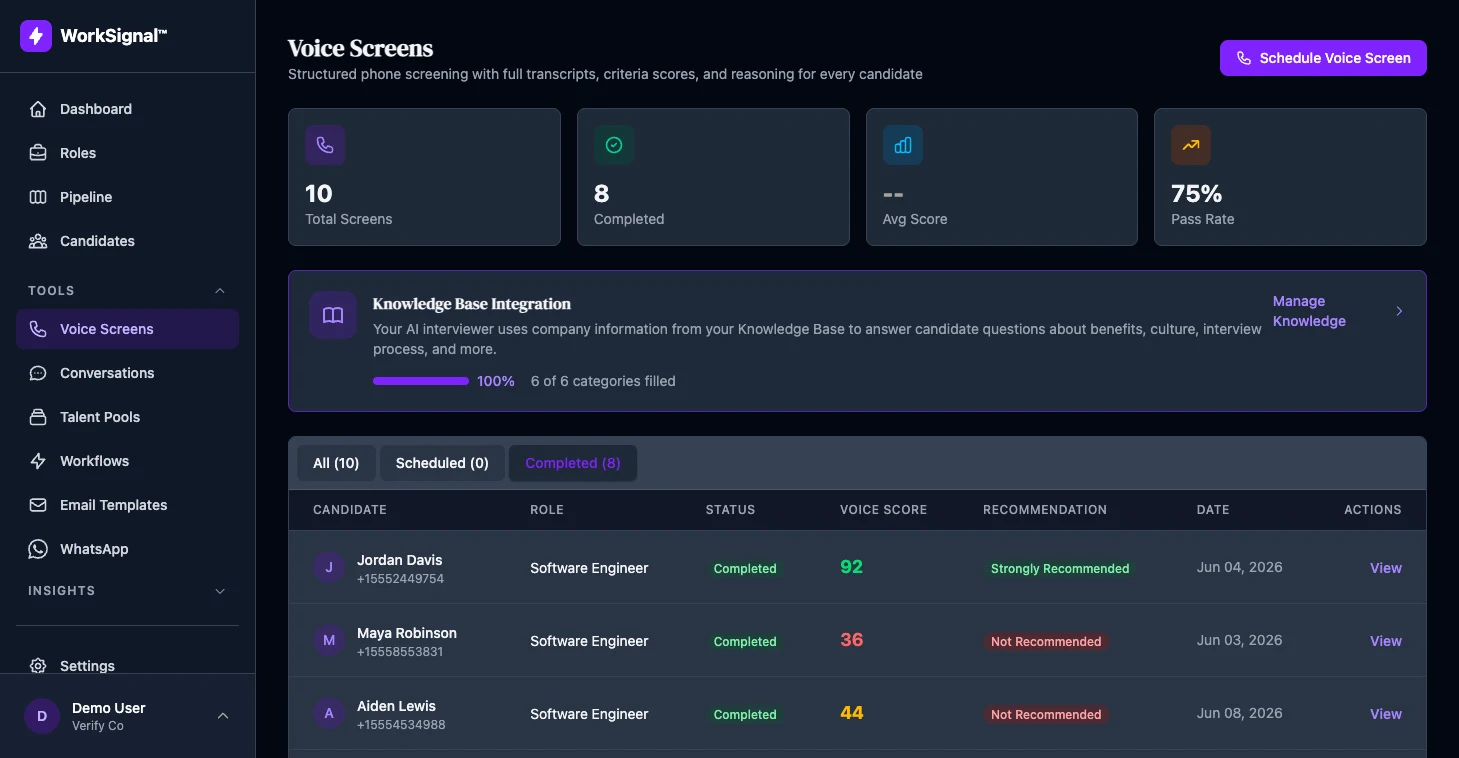
Yes. WorkSignal runs your exact screening questions as a structured voice screen on a real outbound phone call to every applicant. Each candidate speaks their answers in their own words. WorkSignal returns a full transcript, a score on each question, and a ranked shortlist - so you review the candidates who passed, not every application. Plans are custom-built for your volume. Talk to sales to scope the right package.
Run these questions as a structured voice screen
WorkSignal asks your exact questions on a real phone call to every applicant. You get a transcript, a score on each answer, and a ranked shortlist - without sitting on the phone yourself.
- Real phone call, not a chatbot or async video
- Your questions, scored and transcribed automatically
- Ranked shortlist delivered to your inbox or ATS
- Custom plans built for your volume - no seat fees, no scheduling overhead