Home Health Aide Screening Questions
Home health aides provide care in an environment with minimal direct supervision, which makes reliability, sound judgment, and genuine warmth non-negotiable. Unlike facility-based care, HHAs must be self-directed and resourceful while also maintaining the communication habits that keep supervisors and families informed. These questions identify candidates who are both clinically capable and independently trustworthy.
10 questions across 4 categories
"Do you hold a current HHA, PCA, or CNA certification, and in which state? What training program did you complete?"
What to listen for
Certification requirements vary by state and by payer source (Medicaid, Medicare-certified agencies have strict requirements). Confirm the certification is current and appropriate for the care level this role involves.
"Do you have reliable personal transportation and a valid driver's license? Our service area spans [X miles/Y neighborhoods]. Is that geography workable for you?"
What to listen for
Transportation is a top reason for no-shows in home care. A direct yes with specifics about their vehicle is the answer you want. Public transit dependency in a sprawling service area requires a candid conversation about reliability.
"Our schedule is built on four-hour and eight-hour shifts across multiple clients per day, with occasional split shifts. Does that structure work for your schedule?"
What to listen for
Multi-client days require reliable transition time between assignments. Listen for whether they ask clarifying questions about drive time, which is a good sign they understand the logistics. Rigid scheduling expectations are worth probing.
"Tell me about a client you cared for where something unexpected happened mid-visit. What did you do?"
What to listen for
Home health emergencies require fast, calm decision-making without a charge nurse down the hall. Candidates should describe assessing the situation, contacting the office or emergency services as appropriate, and staying with the client. Panic or delayed escalation are red flags.
"Tell me about a client relationship that was challenging. What made it difficult, and how did you manage it over time?"
What to listen for
Home care requires sustained patience with clients who may be resistant, lonely, confused, or grieving. Candidates who describe building rapport through consistency and small accommodations show long-term relational skill.
"What would you do if you arrived at a client's home and they did not answer the door, and their phone was going to voicemail?"
What to listen for
This is a safety and protocol question. Candidates should describe contacting the office immediately, attempting secondary emergency contacts if provided, and not leaving until instructed by a supervisor. Independent decision-making that bypasses the office is a serious concern.
"How do you handle a situation where a client or family member asks you to do something outside your scope of care - for example, administering medication or performing a wound dressing?"
What to listen for
Candidates must clearly understand scope of practice and be able to explain that boundary to a client without damaging the relationship. The correct answer involves refusing the task, explaining their role, and escalating to the supervising nurse.
"What is your experience with clients who have Alzheimer's or dementia? How do you handle agitation or refusal of care?"
What to listen for
Look for person-centered techniques - distraction, validation, calm tone, flexibility with care timing. Candidates who describe working around agitation rather than forcing compliance understand dignity-preserving care.
"Are you comfortable with personal care tasks - bathing, toileting, wound observation, catheter care - as a routine part of every visit?"
What to listen for
Direct question about care comfort is necessary for this role. Some candidates are experienced with ADL support but uncomfortable with specific tasks. Surface any hesitations now rather than on the first visit with a client who needs that level of care.
"How do you document care visits - what systems have you used, and how do you handle a situation where you forgot to log something?"
What to listen for
Electronic visit verification is now required for Medicaid home care in most states. Candidates who know EVV and can describe their documentation habits are lower-risk for compliance issues. Acknowledge-and-correct on missed entries is a mature answer.
Practical tips
Getting more from your home health aide screens
Ask about their longest client relationship and why it ended. HHAs who have maintained 12-plus month relationships with the same client - even through difficult periods - are significantly more likely to be retained by your agency long-term.
Confirm EVV compliance comfort early. Many states require electronic visit verification for Medicaid billing and an HHA who resists or struggles with the app creates billing and audit risk.
Transportation issues are the number one operational problem in home care scheduling. Get specific about their vehicle reliability, coverage when a car is out, and their backup plan. Vague reassurances should prompt a follow-up question.
FAQ
Common questions about phone screening home health aide candidates
How many screening questions should I ask a home health aide candidate?
For a phone screen, 8 to 12 questions is the right range for a home health aide role. The goal is to verify the must-have qualifications, assess reliability, and surface any schedule or logistical constraints before investing in an in-person interview. Keep the call to 15-20 minutes. A structured voice screen through WorkSignal asks your exact questions on a real phone call and returns transcripts and scores for every applicant, so you only spend time on candidates who have already passed the baseline.
What is the most important thing to assess in a home health aide phone screen?
Beyond the specific technical or certification requirements for a home health aide role, the most important thing to assess is schedule reliability and genuine fit with the demands of the job. Most drop-off and early turnover in frontline roles traces back to a mismatch that was visible in the screening conversation but not probed. Use situational questions to get past rehearsed answers and listen for specifics - named situations, real numbers, and honest acknowledgment of challenges.
Can I run these screening questions as an automated phone screen?
Yes. WorkSignal runs your exact screening questions as a structured voice screen on a real outbound phone call to every applicant. Each candidate speaks their answers in their own words. WorkSignal returns a full transcript, a score on each question, and a ranked shortlist - so you review the candidates who passed, not every application. Plans are custom-built for your volume. Talk to sales to scope the right package.
Run these questions as a structured voice screen
WorkSignal asks your exact questions on a real phone call to every applicant. You get a transcript, a score on each answer, and a ranked shortlist - without sitting on the phone yourself.
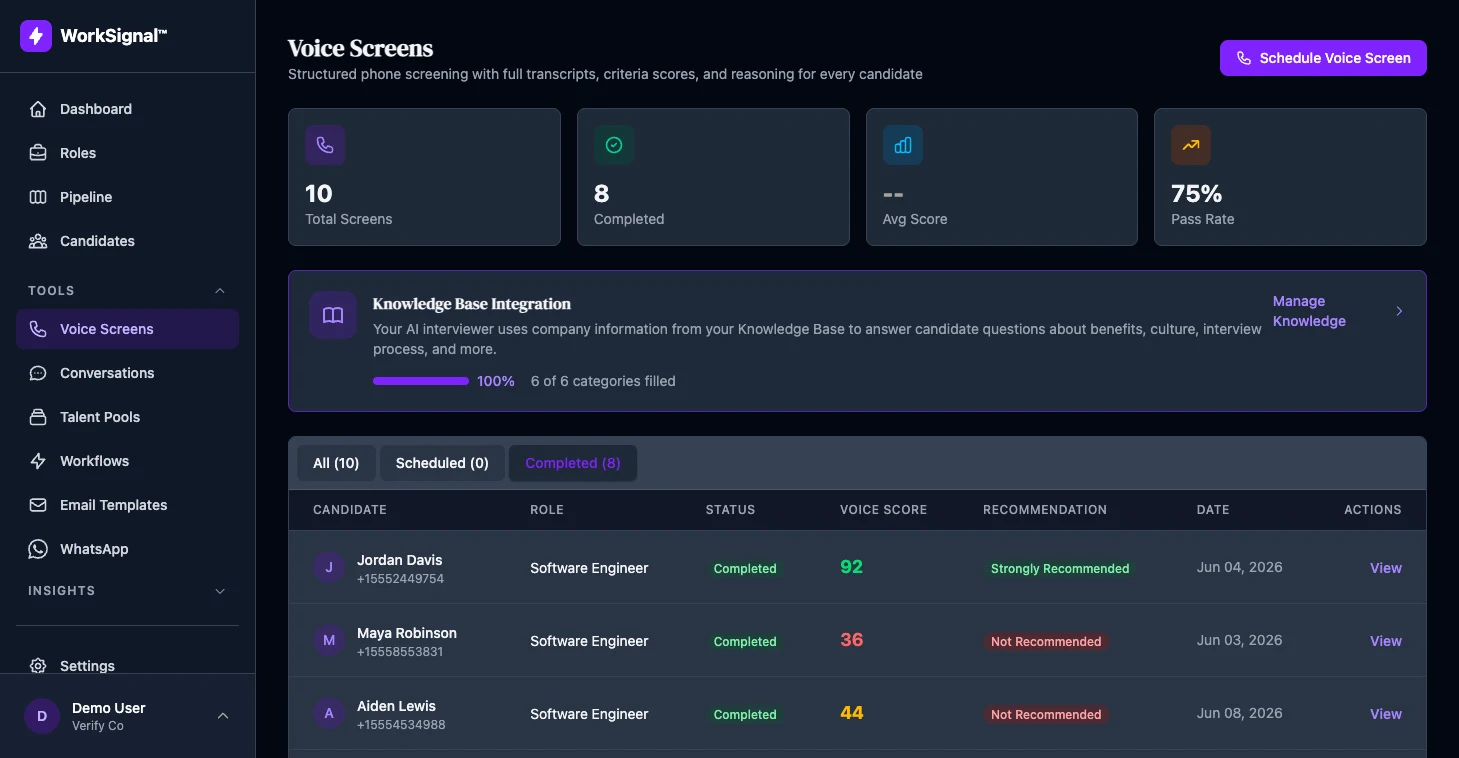
- Real phone call, not a chatbot or async video
- Your questions, scored and transcribed automatically
- Ranked shortlist delivered to your inbox or ATS
- Custom plans built for your volume - no seat fees, no scheduling overhead