Front Desk Receptionist Screening Questions
A front desk receptionist is often the first human interaction a visitor, patient, or client has with your organization. The screen should surface candidates who are naturally warm, organizationally reliable, and able to manage competing demands without appearing flustered. These questions identify the candidates who thrive in a role that looks simple from the outside but requires real coordination skill and interpersonal maturity.
10 questions across 4 categories
"Tell me about the highest-volume front desk or reception role you have held. What was a typical hour like, and what made it manageable?"
What to listen for
Look for candidates who describe a structured approach to managing simultaneous demands - greeting visitors while on a call, queuing requests, communicating with back-office staff. Candidates who describe the volume as chaotic without a management strategy may struggle in a busy environment.
"What multi-line phone systems have you used, and how many lines were you typically managing at once?"
What to listen for
Experience with specific systems (Avaya, Cisco, RingCentral) matters less than comfort with hold management, transferring to the correct extension, and accurate message-taking. Candidates who have only handled single-line calls may need more supervision.
"What scheduling or visitor management software have you used? How did you handle appointment check-ins and updates in real time?"
What to listen for
Note specific systems - Envoy, Traction Guest, Calendly for scheduling, or industry-specific EHR check-in systems in healthcare. Real-time accuracy under interruption is the core skill here.
"Have you managed mail intake, courier coordination, or supply ordering as part of a reception role? What was your system?"
What to listen for
Many front desk roles include administrative responsibilities beyond the desk itself. Candidates who have developed their own lightweight systems for mail distribution or supply tracking are more reliably thorough.
"Describe a time a visitor arrived without an appointment and needed to see someone who was not available. How did you handle it?"
What to listen for
Strong candidates describe managing the visitor's expectations professionally, notifying the appropriate staff member discreetly, and offering a path forward - a scheduled appointment or a message. Candidates who either turn away visitors abruptly or escalate unnecessarily show the two failure modes for this situation.
"Tell me about a time a visitor or caller was hostile or rude to you directly. What did you do?"
What to listen for
Receptionists absorb a significant amount of frustration that is not actually directed at them. Candidates who describe staying calm, not taking it personally, and finding a path to de-escalation without abandoning professionalism show the emotional resilience this role requires.
"Our front desk covers 8am to 5pm Monday through Friday with no remote option. Is that schedule reliable for you?"
What to listen for
Receptionist roles are non-negotiably in-person and schedule-bound. A direct yes is what you need. Probe for transportation reliability and backup plans - reception coverage gaps affect the entire operation.
"Is there anything about your current situation - transportation, other commitments, or schedule - that could affect your reliability in this role?"
What to listen for
Ask this directly and listen carefully. Reception is one of the highest-impact roles for absence coverage because there is no remote backup. Candidates who surface constraints now give you the opportunity to problem-solve before the start date.
"What does a clean handoff look like when you are leaving for the day and the evening or next-day coverage is starting?"
What to listen for
This tests whether they think about continuity. Strong answers include pending messages, visitor logs, any unresolved requests, scheduled arrivals, and anything that needs follow-up. Candidates who leave without a structured handoff create coverage gaps.
"How do you prioritize when the phone is ringing, a visitor is waiting at the desk, and someone from the office is asking you a question simultaneously?"
What to listen for
The prioritization question has no single right answer, but candidates should describe a consistent, communicative approach - acknowledging each demand briefly, working through them in a clear order, and making the visitor or caller feel heard even when they are waiting.
Practical tips
Getting more from your front desk receptionist screens
Notice how the candidate presents on the phone screen itself - their warmth, pace, clarity, and how they handle a moment of uncertainty. Front desk candidates who come across as cold or disorganized on a scheduled call are rarely warmer with unscheduled visitors.
Ask for a reference who can speak specifically to their phone and visitor management experience, not just general character. Front desk performance is observable and your reference should be able to describe specific situations.
Reliability is the hardest quality to assess in a screen. Ask about their longest tenure in a prior role and what drove their departure. Candidates with multiple short tenures in reception roles are worth probing on what made those situations unsustainable.
FAQ
Common questions about phone screening front desk receptionist candidates
How many screening questions should I ask a front desk receptionist candidate?
For a phone screen, 8 to 12 questions is the right range for a front desk receptionist role. The goal is to verify the must-have qualifications, assess reliability, and surface any schedule or logistical constraints before investing in an in-person interview. Keep the call to 15-20 minutes. A structured voice screen through WorkSignal asks your exact questions on a real phone call and returns transcripts and scores for every applicant, so you only spend time on candidates who have already passed the baseline.
What is the most important thing to assess in a front desk receptionist phone screen?
Beyond the specific technical or certification requirements for a front desk receptionist role, the most important thing to assess is schedule reliability and genuine fit with the demands of the job. Most drop-off and early turnover in frontline roles traces back to a mismatch that was visible in the screening conversation but not probed. Use situational questions to get past rehearsed answers and listen for specifics - named situations, real numbers, and honest acknowledgment of challenges.
Can I run these screening questions as an automated phone screen?
Yes. WorkSignal runs your exact screening questions as a structured voice screen on a real outbound phone call to every applicant. Each candidate speaks their answers in their own words. WorkSignal returns a full transcript, a score on each question, and a ranked shortlist - so you review the candidates who passed, not every application. Plans are custom-built for your volume. Talk to sales to scope the right package.
Run these questions as a structured voice screen
WorkSignal asks your exact questions on a real phone call to every applicant. You get a transcript, a score on each answer, and a ranked shortlist - without sitting on the phone yourself.
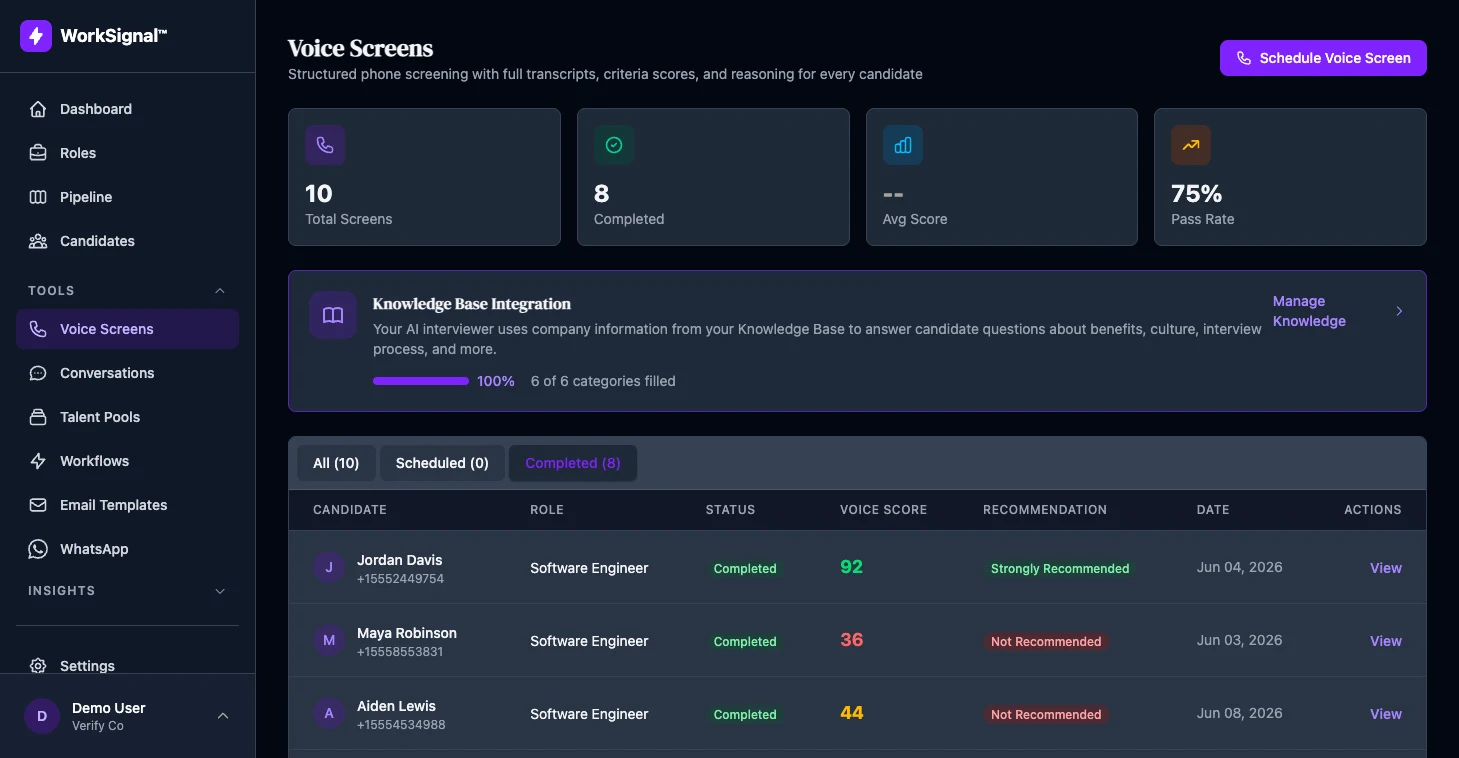
- Real phone call, not a chatbot or async video
- Your questions, scored and transcribed automatically
- Ranked shortlist delivered to your inbox or ATS
- Custom plans built for your volume - no seat fees, no scheduling overhead