Forklift Operator Screening Questions
Forklift operator hiring carries real safety and liability stakes - a credentialed, safety-conscious operator protects your team, your facility, and your inventory. A strong phone screen confirms current certification status, identifies which equipment types they have actually operated, and surfaces the safety habits that predict incident-free tenure. These questions get past the resume to the candidate's actual on-the-floor experience.
10 questions across 4 categories
"Is your forklift certification current? What types of equipment were you certified to operate, and at which employer was that certification issued?"
What to listen for
OSHA requires site-specific certification - a certification from a prior employer is not automatically valid at your facility. Current means within the last three years. Note which equipment types are covered, and flag any gap between their certification and the equipment they will operate at your site.
"Our operation runs two shifts - 6am to 2:30pm and 2:30pm to 11pm - with the shift assigned based on seniority. New operators typically start on the afternoon shift. Does that work for your schedule?"
What to listen for
Listen for a direct answer. Afternoon shift availability is a common blocker for candidates with childcare or second-job constraints. Surface this now rather than after you have invested in training.
"What types of forklifts have you operated? Walk me through the differences in how you handle a sit-down counterbalance versus a reach truck or order picker."
What to listen for
Candidates who have operated multiple equipment types should be able to describe actual operational differences - mast tilt, turning radius, load center. Candidates who merge all forklifts into one generic description likely have limited multi-equipment exposure.
"Tell me about the largest or most challenging load you have moved. What made it difficult and how did you approach it?"
What to listen for
Look for load assessment instinct - checking stability, adjusting tilt, confirming weight limits before picking. Candidates who prioritize speed over load stability assessment are an incident risk.
"Have you worked in a narrow-aisle or very narrow-aisle environment? What was the aisle width and how did you adapt your operating style?"
What to listen for
Narrow-aisle (less than 8 feet) and VNA (less than 6 feet) operation requires substantially different technique. Candidates who have only operated in wide-aisle warehouses will need close supervision in a tight environment.
"Do you have experience with WMS-integrated RF scanning for pick-and-put tasks? Which systems?"
What to listen for
Many high-throughput warehouses require scan-confirm on every pick. Candidates comfortable with RF-directed work are faster to full productivity. Note specific WMS platforms - Manhattan, SAP EWM, NetSuite WMS, Blue Yonder.
"Walk me through your pre-shift equipment inspection. What do you check and in what order?"
What to listen for
The answer should include hydraulic fluid, forks for cracks or bends, tires, horn, lights, seatbelt, battery charge level (for electric), and LPG connection (for propane). Missing the OSHA-required daily inspection is a compliance flag.
"Describe what you would do if you noticed a pedestrian walking into your travel path in a mixed-traffic zone."
What to listen for
Pedestrian right-of-way is non-negotiable. The answer should be stop immediately, use the horn, wait for the pedestrian to clear, and then proceed. Any answer that minimizes the stop or involves moving around the pedestrian is a disqualifier.
"What is the maximum weight capacity of the heaviest forklift you have operated, and how did you verify load capacity before picking an unfamiliar load?"
What to listen for
Candidates should describe checking the data plate on the forklift for capacity at the specified load center. Estimating or ignoring weight verification is a serious safety gap.
"Tell me about a time you refused to operate equipment or complete a lift you did not feel was safe. What happened?"
What to listen for
This tests whether they will prioritize safety over production pressure. Candidates who have never refused an unsafe task in a years-long career either work in unusually safe environments or have not developed the habits to recognize and act on unsafe conditions.
Practical tips
Getting more from your forklift operator screens
Conduct a site-specific re-certification before the candidate's first solo shift, regardless of how experienced they are. OSHA 29 CFR 1910.178 requires site-specific evaluation and existing certification from another employer does not satisfy this requirement.
Check incident history by asking for supervisor references from their most recent forklift role specifically. A pattern of minor incidents - clipped racking, product damage, near-misses - is a stronger predictor of serious future incidents than a single event.
Clarify the equipment mix in your facility before the screen and ask targeted questions about each type they will operate. A candidate who is excellent on a counterbalance but has never touched a reach truck needs structured training time before operating independently.
FAQ
Common questions about phone screening forklift operator candidates
How many screening questions should I ask a forklift operator candidate?
For a phone screen, 8 to 12 questions is the right range for a forklift operator role. The goal is to verify the must-have qualifications, assess reliability, and surface any schedule or logistical constraints before investing in an in-person interview. Keep the call to 15-20 minutes. A structured voice screen through WorkSignal asks your exact questions on a real phone call and returns transcripts and scores for every applicant, so you only spend time on candidates who have already passed the baseline.
What is the most important thing to assess in a forklift operator phone screen?
Beyond the specific technical or certification requirements for a forklift operator role, the most important thing to assess is schedule reliability and genuine fit with the demands of the job. Most drop-off and early turnover in frontline roles traces back to a mismatch that was visible in the screening conversation but not probed. Use situational questions to get past rehearsed answers and listen for specifics - named situations, real numbers, and honest acknowledgment of challenges.
Can I run these screening questions as an automated phone screen?
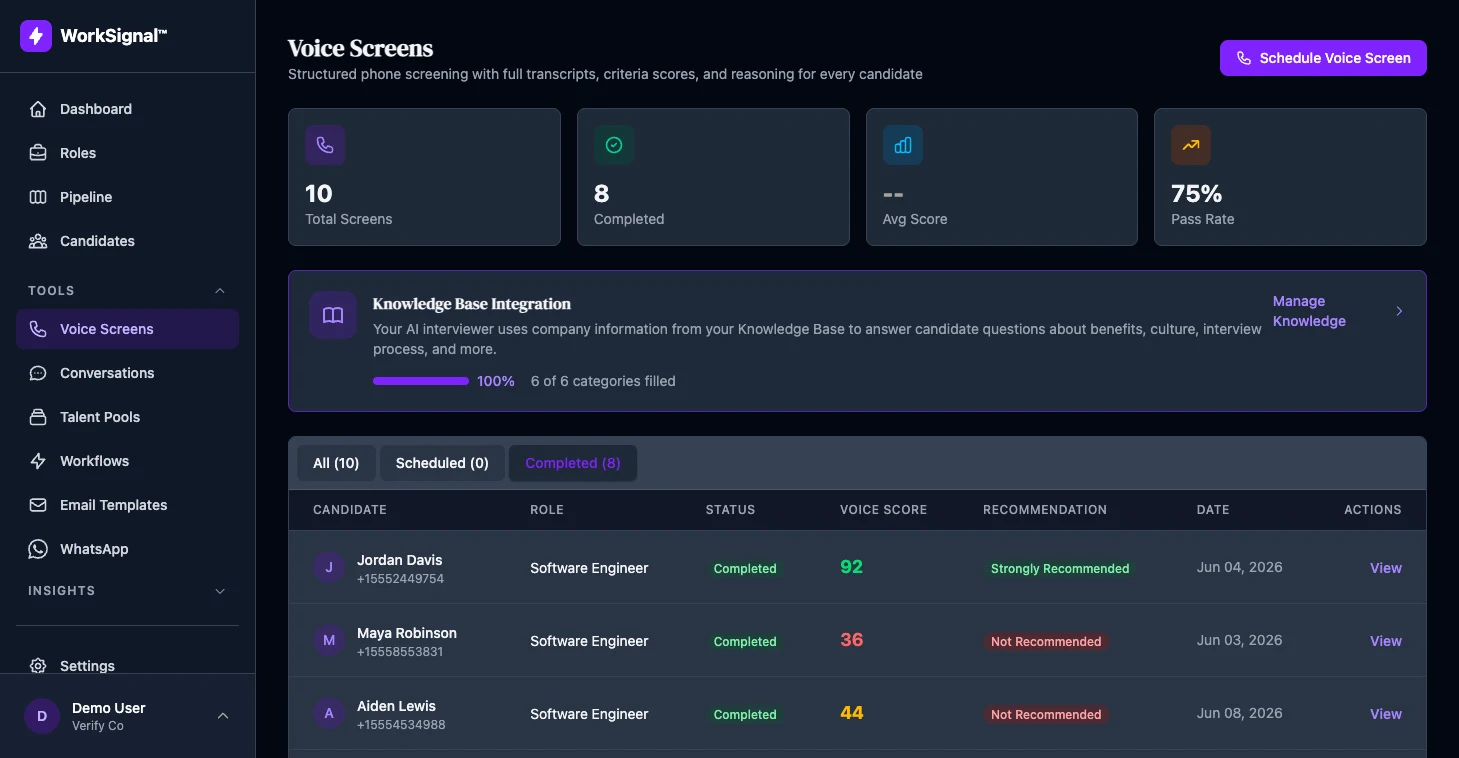
Yes. WorkSignal runs your exact screening questions as a structured voice screen on a real outbound phone call to every applicant. Each candidate speaks their answers in their own words. WorkSignal returns a full transcript, a score on each question, and a ranked shortlist - so you review the candidates who passed, not every application. Plans are custom-built for your volume. Talk to sales to scope the right package.
Run these questions as a structured voice screen
WorkSignal asks your exact questions on a real phone call to every applicant. You get a transcript, a score on each answer, and a ranked shortlist - without sitting on the phone yourself.
- Real phone call, not a chatbot or async video
- Your questions, scored and transcribed automatically
- Ranked shortlist delivered to your inbox or ATS
- Custom plans built for your volume - no seat fees, no scheduling overhead