Dispatcher Screening Questions
Dispatchers manage high-stakes communication and coordination in real time, often without a supervisor in the loop. The phone screen is particularly important for this role because you can directly observe how the candidate communicates under structured pressure. Look for composure, clear verbal organization, and the ability to gather information efficiently without unnecessary back-and-forth. These questions are designed to surface the candidates who perform, not just present.
11 questions across 4 categories
"Walk me through a shift where multiple high-priority calls or assignments came in at the same time. How did you decide what to handle first?"
What to listen for
Look for a clear prioritization framework - life safety, time-sensitive, then operational. Candidates who describe freezing or deferring all decisions to a supervisor when overwhelmed will struggle in fast-tempo dispatch environments.
"Tell me about a time a field unit gave you incorrect or incomplete information that affected your decisions. How did you handle it?"
What to listen for
Candidates should describe their verification habits - confirming location, asking clarifying questions, documenting what was received. Passing along unverified information without flagging uncertainty is a serious risk in any dispatch context.
"Tell me about the most stressful single event or incident you dispatched. Walk me through it from your first awareness to resolution."
What to listen for
The narrative should be organized and sequential. Candidates who can reconstruct a complex event clearly - even a high-stress one - demonstrate the operational memory and composure that defines strong dispatch performance. Watch for emotional flooding that disrupts the narrative.
"What would you do if a field unit stopped responding to radio and phone contact during an active assignment?"
What to listen for
Candidates should describe escalating immediately - alerting a supervisor, attempting all available contact methods, and dispatching a welfare check. Waiting to see if the unit checks in is not an acceptable answer.
"What dispatch or CAD software have you used? How quickly do you typically get up to speed on a new system?"
What to listen for
Note specific platforms - Spillman/Motorola, CentralSquare, Zetron, or industry-specific tools for trucking or field service. Candidates who can describe adapting to a new CAD system mid-career show the learning agility dispatch tech turnover often requires.
"Have you worked in a multi-agency or shared dispatch environment? How did you manage communication handoffs between agencies or departments?"
What to listen for
Multi-agency dispatch requires strict protocol adherence, especially on handoffs. Candidates who have experience with this and can describe their handoff documentation habits are strong candidates for complex dispatch environments.
"Do you have any experience with GPS fleet tracking or AVL systems? How did you use that data during active dispatching?"
What to listen for
Real-time vehicle location data changes how dispatchers prioritize and respond. Candidates who actively use AVL - not just acknowledge it exists - make faster, more accurate unit assignments.
"How do you manage radio traffic when two or more units are trying to reach you simultaneously?"
What to listen for
Strong dispatchers describe acknowledging both units, establishing who has priority, and working through each call cleanly. The ability to hold one channel while actively processing another is a core dispatch skill. Candidates who have never developed a protocol for this will create communication gaps.
"Describe your process for updating field units on a situation that has changed significantly since they were dispatched."
What to listen for
This tests whether they understand that keeping the field informed is an active responsibility, not a reactive one. Candidates who wait for units to check in rather than proactively pushing updates create avoidable risk.
"This position requires working 12-hour shifts on a rotating schedule that includes nights and weekends. Is that consistent with what you have done before, and does it work for your current situation?"
What to listen for
Night and rotating shift availability is a hard requirement for most dispatch roles. A direct, comfortable answer from a candidate who has worked that pattern before is significantly more reliable than assurance from someone who has only worked days.
"Are there any schedule constraints I should know about - days you consistently cannot work, or commitments that affect your availability for overtime or emergency callbacks?"
What to listen for
Dispatch operations often require mandatory overtime or callback during major incidents. Surface constraints now. Candidates who are genuinely available are a much lower operational risk than those who discover limitations after they are on the schedule.
Practical tips
Getting more from your dispatcher screens
Observe how the candidate communicates during the phone screen itself - their ability to give organized, concise answers under conversational pressure is a direct preview of their radio communication quality. Dispatchers who ramble or lose the thread verbally tend to do the same under operational pressure.
Ask for a reference from their most recent dispatch supervisor specifically, not a general professional reference. Dispatch performance is highly observable and supervisors who have monitored actual call volume, accuracy, and composure will give you the most useful assessment.
If the role is in emergency services, check your state's requirements for APCO dispatcher certification or training. Some jurisdictions require specific dispatch training that goes beyond general experience.
FAQ
Common questions about phone screening dispatcher candidates
How many screening questions should I ask a dispatcher candidate?
For a phone screen, 8 to 12 questions is the right range for a dispatcher role. The goal is to verify the must-have qualifications, assess reliability, and surface any schedule or logistical constraints before investing in an in-person interview. Keep the call to 15-20 minutes. A structured voice screen through WorkSignal asks your exact questions on a real phone call and returns transcripts and scores for every applicant, so you only spend time on candidates who have already passed the baseline.
What is the most important thing to assess in a dispatcher phone screen?
Beyond the specific technical or certification requirements for a dispatcher role, the most important thing to assess is schedule reliability and genuine fit with the demands of the job. Most drop-off and early turnover in frontline roles traces back to a mismatch that was visible in the screening conversation but not probed. Use situational questions to get past rehearsed answers and listen for specifics - named situations, real numbers, and honest acknowledgment of challenges.
Can I run these screening questions as an automated phone screen?
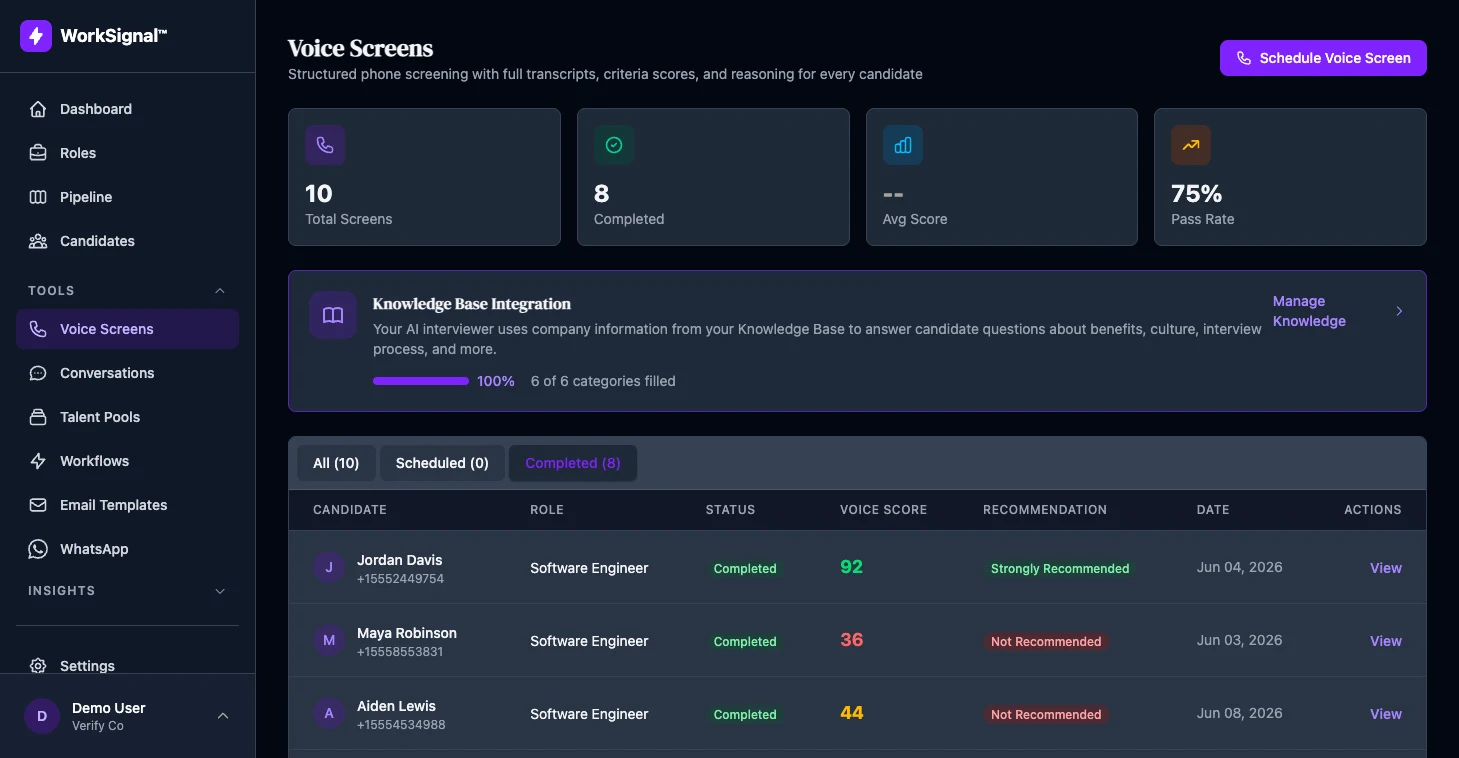
Yes. WorkSignal runs your exact screening questions as a structured voice screen on a real outbound phone call to every applicant. Each candidate speaks their answers in their own words. WorkSignal returns a full transcript, a score on each question, and a ranked shortlist - so you review the candidates who passed, not every application. Plans are custom-built for your volume. Talk to sales to scope the right package.
Run these questions as a structured voice screen
WorkSignal asks your exact questions on a real phone call to every applicant. You get a transcript, a score on each answer, and a ranked shortlist - without sitting on the phone yourself.
- Real phone call, not a chatbot or async video
- Your questions, scored and transcribed automatically
- Ranked shortlist delivered to your inbox or ATS
- Custom plans built for your volume - no seat fees, no scheduling overhead