Customer Service Representative Screening Questions
Customer service roles live or die on communication clarity, patience under pressure, and the ability to own a problem without owning blame. A strong phone screen identifies candidates who stay calm when callers are not, who know how to set expectations honestly, and who treat the job as a craft rather than just a stepping stone. These questions go past the generic to find the people who are genuinely good at this work.
11 questions across 4 categories
"Tell me about a customer interaction that was genuinely difficult - not just frustrated, but escalating - and walk me through exactly what you did."
What to listen for
Look for a specific scenario with a clear resolution. Candidates who acknowledge the customer's frustration before moving to problem-solving show de-escalation instinct. Candidates who jump straight to the policy or the solution often struggle with genuinely upset callers.
"Describe a time you had to tell a customer something they did not want to hear. How did you handle it?"
What to listen for
Candidates should describe setting the expectation early, explaining the reason plainly, and offering what they could do rather than dwelling on what they could not. Candidates who softened bad news to the point of misleading the customer are a risk for complaints.
"Tell me about a policy or rule that made a customer situation harder to resolve. How did you navigate it?"
What to listen for
This tests whether they can work within constraints without abandoning the customer. Strong answers include creative escalation paths or compensation offers within their authority. Candidates who bypassed policy entirely are a compliance risk.
"What CRM or ticketing systems have you used in a customer-facing role? How did you use them during a call?"
What to listen for
Note specific systems - Zendesk, Salesforce Service Cloud, Freshdesk, HubSpot. More importantly, listen for whether they can talk to logging while active on a call. Multitasking between conversation and documentation is a trainable but time-consuming skill to develop.
"Have you worked a queue that required you to handle multiple chat conversations simultaneously? How did you manage that?"
What to listen for
Concurrent chat requires a different workflow from voice. Candidates who have done it should describe their system for tracking where each conversation is. This matters if the role has chat components.
"What is your average handle time goal in your current or most recent role, and how do you balance thoroughness with efficiency?"
What to listen for
Even if they do not remember exact numbers, they should understand the concept of handle time and be able to articulate the trade-off. Candidates who have never thought about this are often slower to self-manage queue pressure.
"How do you reset mentally between a difficult interaction and your next contact? What is your actual process?"
What to listen for
This is not a wellness question - it is a performance question. Candidates who carry frustration from one call into the next create compounding quality problems. Listen for a genuine, practical reset habit rather than a polished non-answer.
"What does a first call resolution mean to you, and what gets in the way of it?"
What to listen for
Candidates who understand FCR as a real customer outcome - not just a metric - tend to own problems more completely. Answers about systemic blockers (missing access, unclear policy) are more sophisticated than blaming the customer.
"Our team handles approximately 60 to 80 contacts per day via phone and chat. Is that volume range consistent with what you have managed before?"
What to listen for
If they are coming from a lower-volume environment, probe for how they think they would adapt. High-volume customer service is a different skill set from deliberate, lower-volume support.
"Our support hours are Monday through Saturday, 8am to 8pm, on a rotating schedule. Does that work for you reliably?"
What to listen for
A direct answer is what you need. Probe for weekend availability specifically - that is often where the real constraint surfaces in contact center roles.
"Is there a schedule or availability constraint I should know about before we move forward?"
What to listen for
Ask this directly near the end of the screen. Transportation, childcare, second jobs, or enrollment status can all affect attendance. Better to surface this now than after an offer.
Practical tips
Getting more from your customer service representative screens
Conduct part of the screen as if it were a difficult customer call - note whether the candidate adjusts their tone and stays engaged when you push back lightly. Candidates who perform well under simulated friction almost always perform better on the floor.
Probe for specific handle time metrics and quality scores from prior roles. Candidates who have worked in environments with real accountability structures are faster to integrate into a performance-managed team.
Check for comfort with written communication if chat is part of the role. Ask them to explain a simple refund policy in their own words during the call. Written clarity under time pressure is a distinct skill from verbal communication.
FAQ
Common questions about phone screening customer service representative candidates
How many screening questions should I ask a customer service representative candidate?
For a phone screen, 8 to 12 questions is the right range for a customer service representative role. The goal is to verify the must-have qualifications, assess reliability, and surface any schedule or logistical constraints before investing in an in-person interview. Keep the call to 15-20 minutes. A structured voice screen through WorkSignal asks your exact questions on a real phone call and returns transcripts and scores for every applicant, so you only spend time on candidates who have already passed the baseline.
What is the most important thing to assess in a customer service representative phone screen?
Beyond the specific technical or certification requirements for a customer service representative role, the most important thing to assess is schedule reliability and genuine fit with the demands of the job. Most drop-off and early turnover in frontline roles traces back to a mismatch that was visible in the screening conversation but not probed. Use situational questions to get past rehearsed answers and listen for specifics - named situations, real numbers, and honest acknowledgment of challenges.
Can I run these screening questions as an automated phone screen?
Yes. WorkSignal runs your exact screening questions as a structured voice screen on a real outbound phone call to every applicant. Each candidate speaks their answers in their own words. WorkSignal returns a full transcript, a score on each question, and a ranked shortlist - so you review the candidates who passed, not every application. Plans are custom-built for your volume. Talk to sales to scope the right package.
Run these questions as a structured voice screen
WorkSignal asks your exact questions on a real phone call to every applicant. You get a transcript, a score on each answer, and a ranked shortlist - without sitting on the phone yourself.
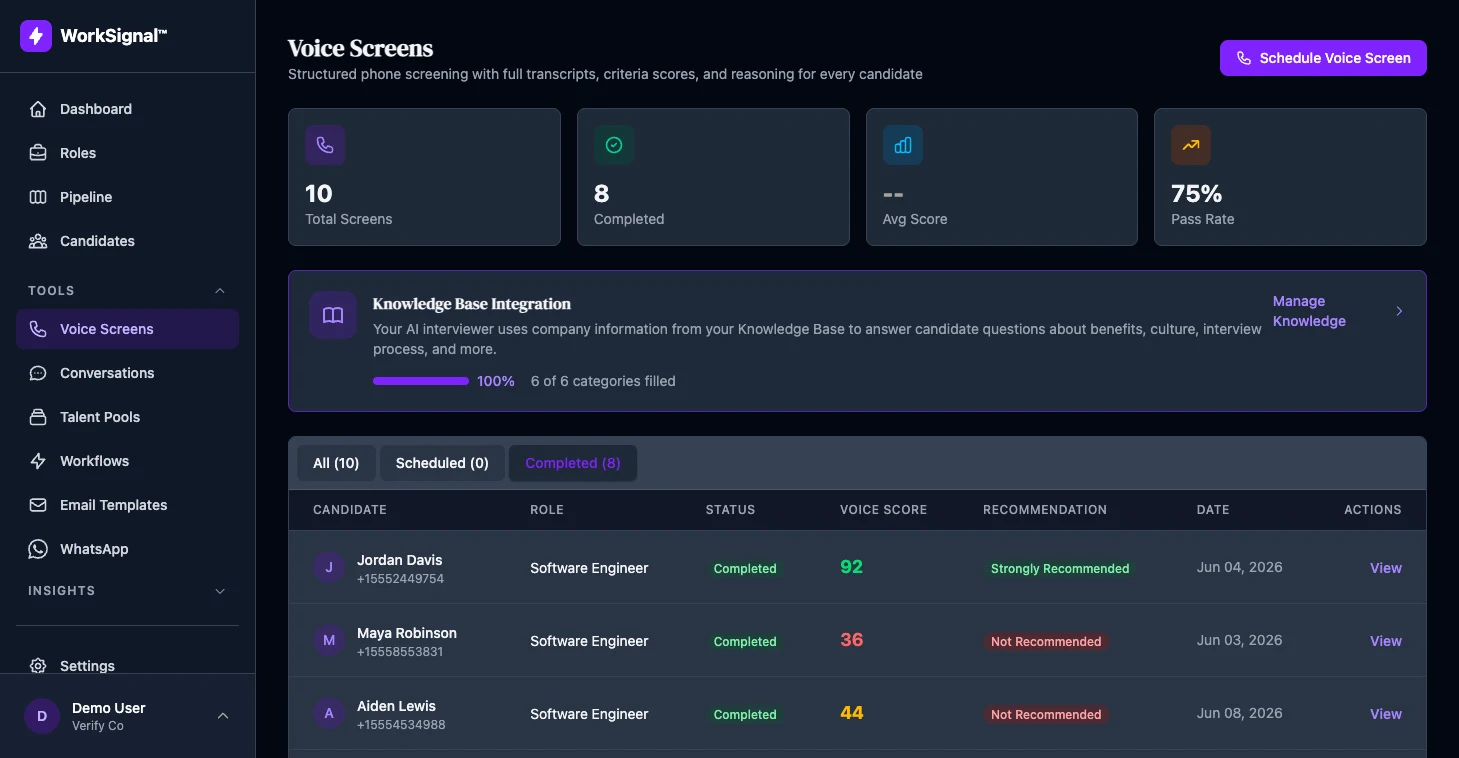
- Real phone call, not a chatbot or async video
- Your questions, scored and transcribed automatically
- Ranked shortlist delivered to your inbox or ATS
- Custom plans built for your volume - no seat fees, no scheduling overhead