Certified Nursing Assistant Screening Questions
Certified nursing assistants work in one of the most physically and emotionally demanding care environments in healthcare. A strong phone screen validates certification currency, lift and transfer competency, and the interpersonal stability required to provide dignified care under pressure. These questions help identify CNAs who are technically sound, schedule-committed, and genuinely motivated by patient outcomes.
10 questions across 4 categories
"Is your CNA certification current, and in which state is it active? When does it expire?"
What to listen for
This is a hard qualification filter. Certification must be current and active in the state where the facility operates. If they are transferring from another state, confirm they understand the reciprocity or re-certification timeline before scheduling an in-person.
"Our facility runs 12-hour shifts, 7am to 7pm and 7pm to 7am, with rotating days and a requirement for one weekend shift every two weeks. Does that schedule work for you?"
What to listen for
Night shift and weekend availability are often the constraint that filters out otherwise qualified candidates. Ask directly and listen for hesitation. A candidate who is uncertain about nights is likely to call out disproportionately on those shifts.
"This role involves regular lifting, repositioning, and physical patient care for an entire 12-hour shift. Is there anything about your current physical condition that would affect your ability to perform those duties consistently?"
What to listen for
An ADA-compliant way to surface accommodation needs before the offer stage. Most candidates will say no. If they raise something, discuss it openly and involve HR appropriately.
"Walk me through your process for a two-person assist transfer from bed to wheelchair for a resident who has limited upper body strength."
What to listen for
Listen for correct sequencing - verbal cuing the resident, confirming the second caregiver is ready, using a gait belt, and controlling the pace. Shortcuts in lift protocol are the leading cause of both resident and caregiver injury.
"What is your experience with residents who have dementia or cognitive decline? How do you approach redirection?"
What to listen for
This is a test of both knowledge and temperament. Candidates should describe person-centered redirection - meeting the resident where they are, using calm tone, avoiding confrontation. Candidates who describe restraint or abrupt correction as a first response are a serious concern.
"If you noticed an unusual change in a resident's skin integrity or vital signs during your shift, what would you do?"
What to listen for
Candidates should describe documenting the change, reporting to the charge nurse immediately, and not waiting for the next shift. CNAs are often the first line of observation - catch-and-report instinct is a critical safety function.
"Tell me about the most medically complex resident or patient you have cared for. What made their care demanding, and how did you manage it?"
What to listen for
Strong candidates will describe a patient with multiple comorbidities or behavioral challenges and explain their specific adaptations - not just that it was hard. This surfaces both clinical experience range and care instinct.
"Have you worked with electronic health records or eMAR systems? Which ones?"
What to listen for
Point Click Care, MatrixCare, and similar systems are common in LTC and post-acute settings. Charting accuracy is a compliance requirement, not optional. Note any systems they know and flag unfamiliarity with digital documentation for training planning.
"What keeps you in direct patient care work? What draws you back to it despite how demanding it is?"
What to listen for
Intrinsic motivation is a strong predictor of retention in CNA roles. Candidates who articulate a genuine connection to the work - the relationships, the dignity of care, the satisfaction of helping - tend to stay longer than candidates who frame it primarily as stable employment.
"Describe a situation where a resident or family member was extremely upset with you or your facility. How did you handle it?"
What to listen for
De-escalation in care settings requires a specific blend of empathy and boundary-setting. Candidates who stayed calm, listened fully, and involved a charge nurse appropriately show the relational maturity this role requires.
Practical tips
Getting more from your certified nursing assistant screens
Always verify certification status through your state's nurse aide registry before extending an offer. Self-reported certification is not sufficient for compliance purposes, and lapsed certifications are more common than candidates admit.
Ask specifically about lift and transfer experience in the care setting you are hiring for - SNF, ALF, and home care have meaningfully different patient acuity and staffing ratios. Experience in one does not automatically transfer to another.
Schedule instability is the top driver of CNA turnover. Be transparent about your actual shift patterns - including which shifts are hardest to fill - during the screen. Candidates who accept a schedule they cannot sustain will leave within 90 days.
FAQ
Common questions about phone screening certified nursing assistant candidates
How many screening questions should I ask a certified nursing assistant candidate?
For a phone screen, 8 to 12 questions is the right range for a certified nursing assistant role. The goal is to verify the must-have qualifications, assess reliability, and surface any schedule or logistical constraints before investing in an in-person interview. Keep the call to 15-20 minutes. A structured voice screen through WorkSignal asks your exact questions on a real phone call and returns transcripts and scores for every applicant, so you only spend time on candidates who have already passed the baseline.
What is the most important thing to assess in a certified nursing assistant phone screen?
Beyond the specific technical or certification requirements for a certified nursing assistant role, the most important thing to assess is schedule reliability and genuine fit with the demands of the job. Most drop-off and early turnover in frontline roles traces back to a mismatch that was visible in the screening conversation but not probed. Use situational questions to get past rehearsed answers and listen for specifics - named situations, real numbers, and honest acknowledgment of challenges.
Can I run these screening questions as an automated phone screen?
Yes. WorkSignal runs your exact screening questions as a structured voice screen on a real outbound phone call to every applicant. Each candidate speaks their answers in their own words. WorkSignal returns a full transcript, a score on each question, and a ranked shortlist - so you review the candidates who passed, not every application. Plans are custom-built for your volume. Talk to sales to scope the right package.
Run these questions as a structured voice screen
WorkSignal asks your exact questions on a real phone call to every applicant. You get a transcript, a score on each answer, and a ranked shortlist - without sitting on the phone yourself.
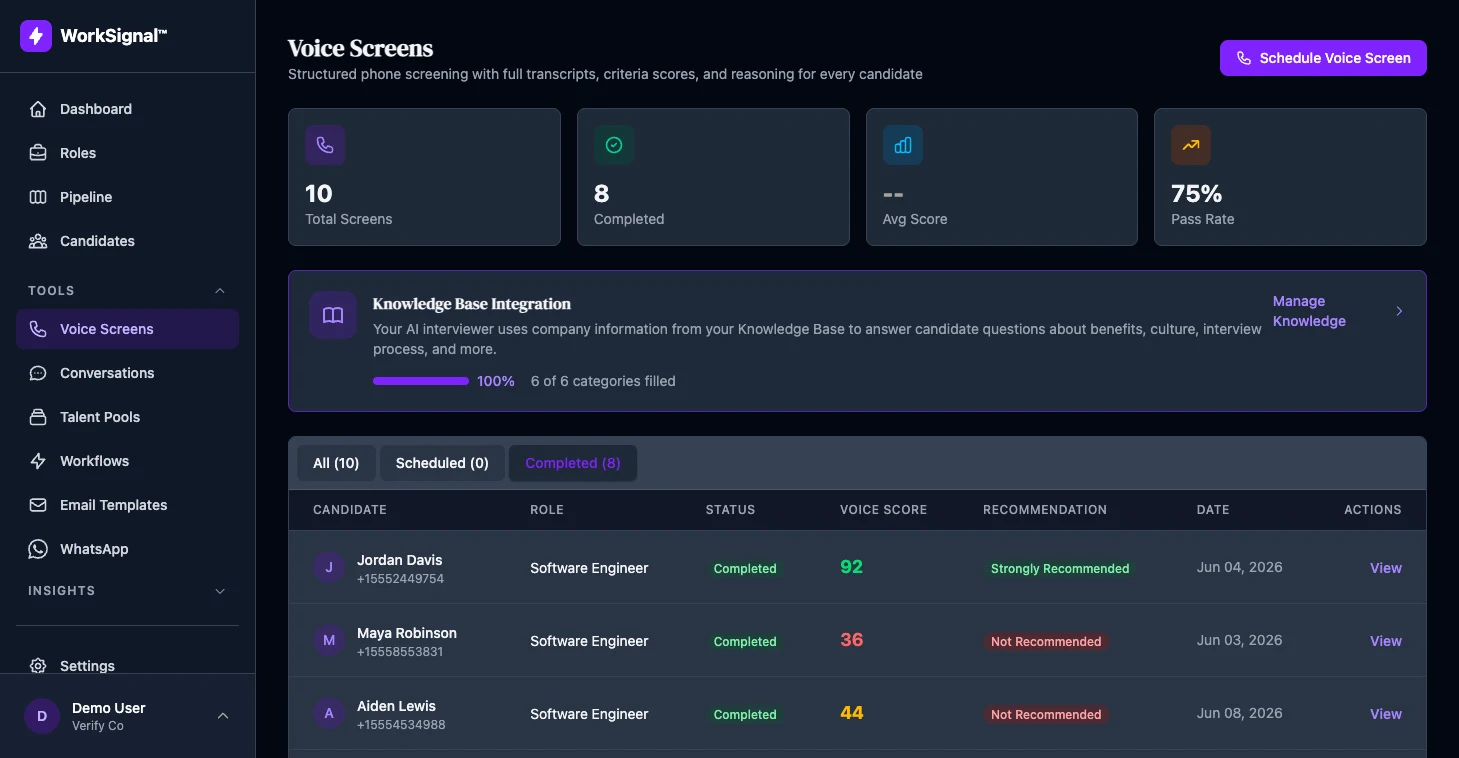
- Real phone call, not a chatbot or async video
- Your questions, scored and transcribed automatically
- Ranked shortlist delivered to your inbox or ATS
- Custom plans built for your volume - no seat fees, no scheduling overhead